

Welcome to the third part of our series highlighting universities and organizations doing great high-impact tutoring work in the WNY Region. You can read part one of our series on Canisius University here and part two of our series on Read To Succeed Buffalo here.
What Exactly is High-Impact Tutoring (HIT)?
In a good article from Ed Week, Susanna Loeb, the founder and executive director of the National Student Support Accelerator, defines HIT - also known as high dosage tutoring - as “one-on-one situations or very small groups meeting at least 30 minutes, three or more times a week.” So high-impact tutoring needs to happen often, during the school day (although summer and after-school learning can be successful with the right frequency & duration), preferably with the same tutor, with high quality instructional materials, and evidence-based.
Other places, including the Colorado Department of Education, the D.C. Office of the State Superintendent of Education, and Texas Education Agency, go a step further in defining high-impact tutoring by specifying that it be “research-based” as well as “data-driven.”
With this in mind, we want to spotlight the work of Ignite Reading, an organization that offers one-to-one foundational reading skills tutoring for schools and districts, and whose tutoring curriculum is based on the work of reading researchers Sharon Walpole, PhD (of Bookworms Curriculum!) and Michael C. McKenna, PhD. Kareem Weaver of Fulcrum Literacy first told us about Ignite, and the incredible results they were seeing. Ignite Reading is now being used in several schools and district in Buffalo and Western New York.

A headline from The 74 Million last month made an intriguing promise — New Research: Done Right, Virtual Tutoring Nearly Rivals In-Person Version. New research shows virtual literacy tutoring could offer a scalable solution to the nation's reading crisis.
As it turns out, a number of schools and districts in cities like Buffalo, Rochester, and Dunkirk are already using a 1:1 virtual tutoring option detailed in the The 74 Million’s article, which explores research completed by the Center for Research and Reform in Education at Johns Hopkins University.
In a quasi-experimental study completed last school year, university researchers followed nearly 2,000 1st graders in 13 high-poverty districts who received virtual tutoring in foundational reading skills from Ignite Reading — the same program providing 1:1 daily tutoring sessions in several locations across WNY.
Student reading growth was substantial — the percentage of students reading on grade level jumped from just 16% in the fall to about 50% by spring. Over the course of a year of tutoring, researchers found that on average the students gained nearly 5 ½ months of additional learning.
Equally significant was the effectiveness of the program when stacked up against other interventions.
Data from the Johns Hopkins study revealed Ignite Reading’s virtual tutoring is 4x more effective than other virtual tutoring options or ed-tech options, and nearly as effective as an in-person model.
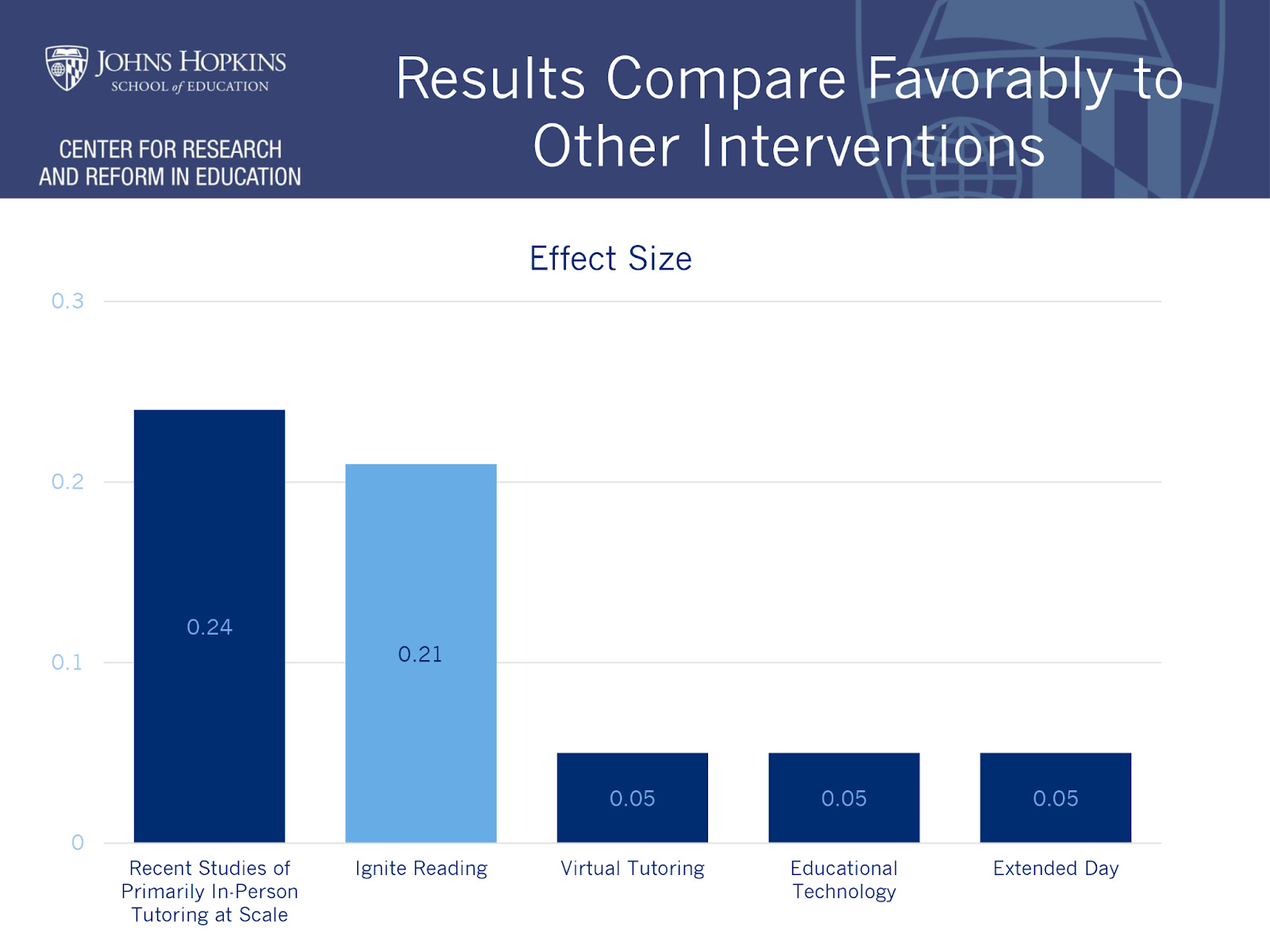
Image Source: Center for Research and Reform at Johns Hopkins University
How can we replicate this reading growth here in Western New York? We reached out to Dana Britt, director of partnerships at Ignite Reading, to learn more about the program’s approach to reading instruction.
Q: What is Ignite Reading, and how does the program work?
Dana Britt: At Ignite Reading, we provide high-dosage tutoring to the students who need extra help mastering foundational reading skills — those core skills that every kid needs to learn in order to be a confident, independent reader.
Thanks to a wealth of scientific research from cognitive scientists and reading researchers who have studied how the brain learns to read, we know that 3 in 5 students require individualized instruction to master these skills so they can learn to read.
Now 3 in 5 students is about 60 percent of the students in a classroom.
Not even the most dedicated teacher teaching a high quality curriculum aligned to the Science of Reading and teaching it with fidelity could possibly provide individualized instruction to that many students.
That’s where we come in. Ignite Reading pairs students with their own tutor for 1:1, 15-minute lessons in those foundational reading skills during the school day so they can close their reading skills gaps and catch up with their peers.
Meanwhile, we’re freeing teachers up to focus on core instruction.
Q: You mentioned that Ignite Reading is virtual. This was one of the more significant points in the Johns Hopkins study which found Ignite Reading’s virtual tutoring program was almost as effective as in-person tutoring and 4 times more effective than other virtual tutoring options, as well as educational technology interventions. What makes your program different from these other virtual supports for students?
Dana Britt: You know, before I joined the Ignite Reading team, I was an ed-tech leader and at one point, I was involved in purchasing ed-tech for one of the biggest school districts in the country — D.C. Public Schools. Let me just say that I have had to eat a serious amount of humble pie!
What we’ve found at Ignite Reading time and time again is there’s just no substitute for the human connection.
Yes, students meet with their tutors online, but something that’s core to the Ignite Reading program is consistency. Kids see their same tutor day after day, week after week, so they aren’t just getting the benefit of evidence-based instruction to build their reading skills, but they’ve also got a cheerleader in their corner who is building their confidence as readers.
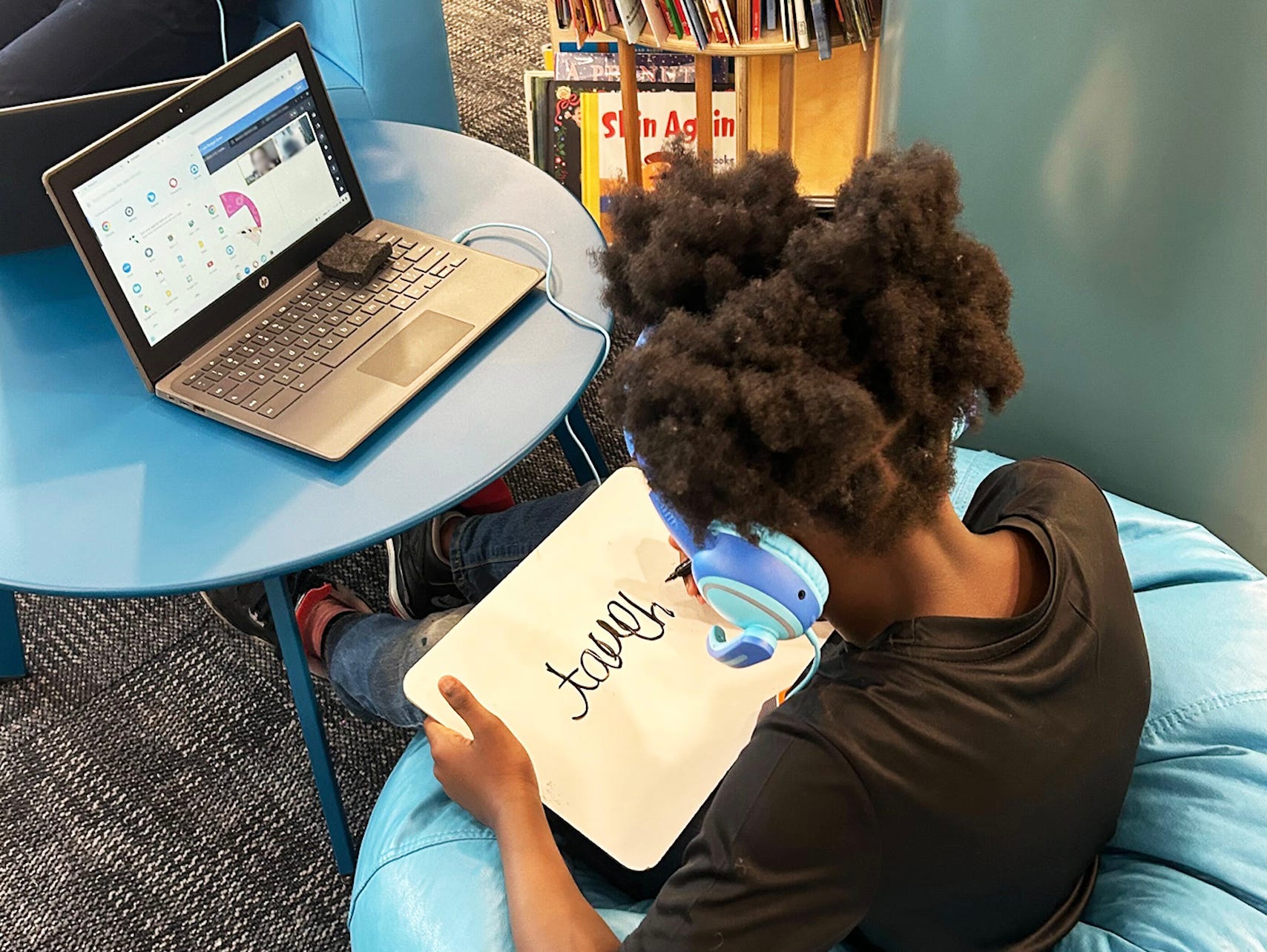
Source: Ignite Reading / Student at Persistence Prep Charter School in Buffalo
The Ignite Reading customer success team also puts a lot of care into pairing students with tutors, so if a student is a multilingual learner, for example, our team will pair them up with a tutor who speaks their native language.
Q: That was another thing that really jumped out at us in the study findings. The huge gains that students made were very similar, if not the same, across all demographics, including students of color, English learners, students who are eligible for free or reduced lunch. To what do you attribute this consistency in gains?
Dana Britt: Yes, we have seen this with our students across the board, and something the researchers told us was kids with the greatest gaps grew the most. They had almost 5x growth, and this group included kids with IEPs and multilingual learners.
What this data really does is dismantle all these ideas and options about which kids can & cannot succeed. It proves that when we give our students what the Science of Reading has already told us they need — this 1:1 instruction, using an evidence-based approach that’s taught with fidelity, they CAN learn to read.
That’s what we do at Ignite Reading. That’s why these students are all able to make these gains.
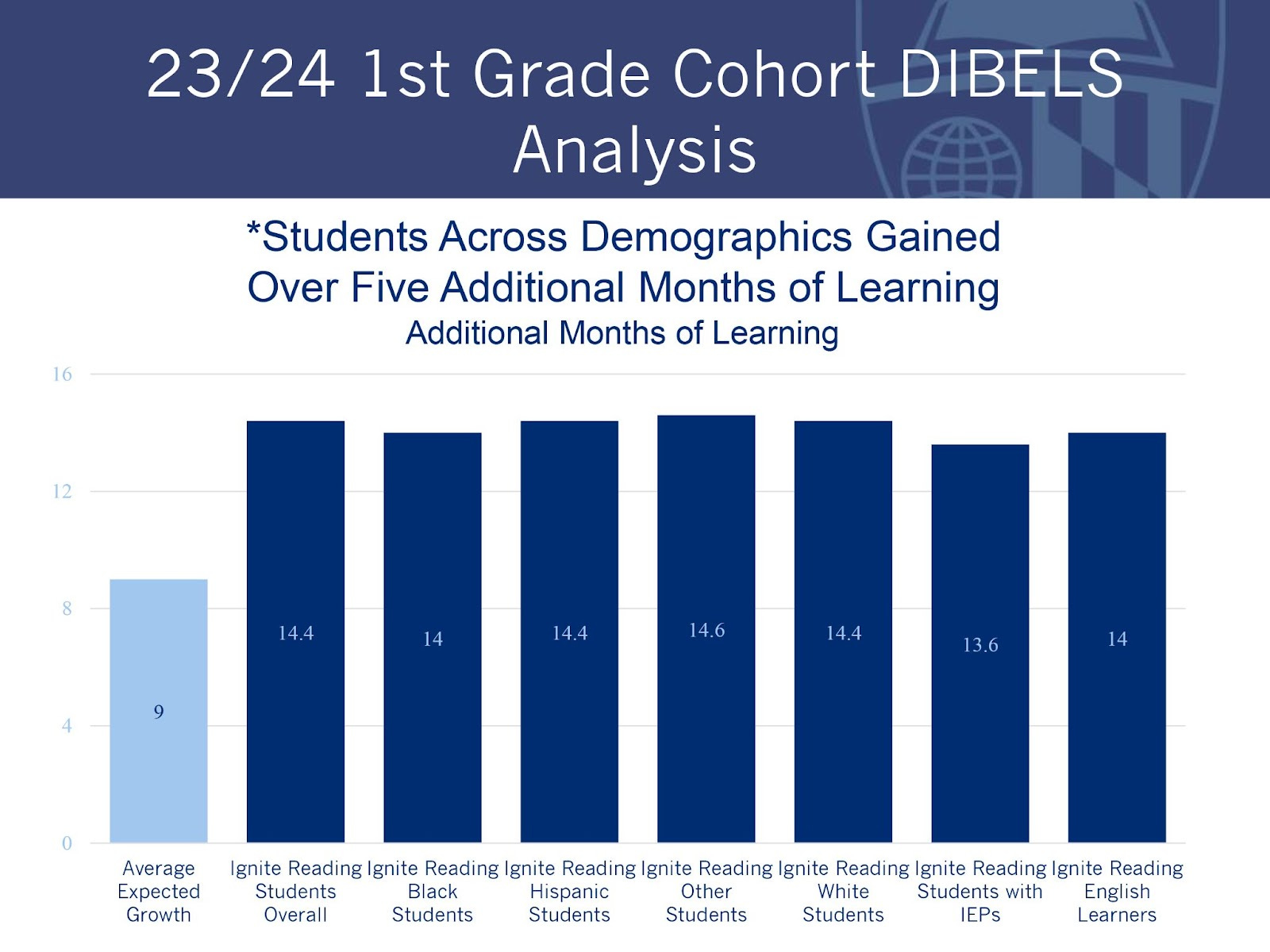
Image Source: Center for Research and Reform at Johns Hopkins University
Q: Schools here in New York State are required to shift to Science of Reading-based literacy instruction this fall. How can virtual literacy tutoring help during that transition?
Dana Britt: We are glad to see that New York has followed the success of other states and what the research says is what's best for kids.
We also know — both from our own experience as educators and from Ignite Reading’s partnerships with districts in states across the country that have adopted Science of Reading policies and laws — that this is a huge undertaking.
Implementing a new curriculum, giving teachers the right PD to learn how to teach a new curriculum — these things don’t happen overnight. Meanwhile New York students rank 32nd in the nation for reading on the National Assessment of Student Progress. These kids can’t wait for a full implementation. They need to learn to read now.
Virtual tutoring is vital to support our teachers and reinforce core instruction during the transition period so these kids — kids who are in 1st grade in fall 2025, when so many of those foundational reading skills are taught — get that evidence-aligned instruction we know they need.
But even once a district has made that full implementation of Science of Reading instruction, even when teachers have the high quality instructional materials they need, even when they’re teaching the new curriculum with fidelity, there are still going to be those 3 in 5 kids who need something more individualized and targeted.
We just cannot expect one teacher to do that, not for 60 percent of the classroom. High-dosage, virtual, 1:1 tutoring like we provide at Ignite Reading is necessary to support those teachers and ensure every single child gets the instruction they need to learn to read.
Want to learn more about Ignite Reading’s high-dosage tutoring program for New York schools and districts? Email Dana Britt at dana.britt@ignite-reading.com.
What We’re Reading / Listening To
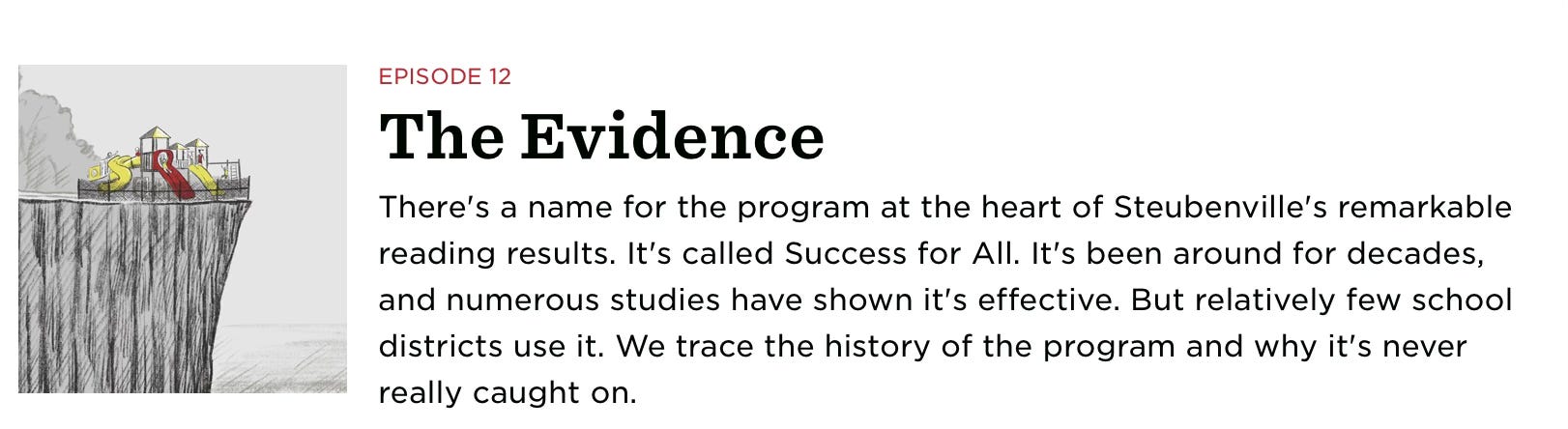
The two NEW episodes of the podcast that swept the education world, “Sold A Story”: Episode 11: “The Outlier” and “Episode 12: “The Evidence.”
The EdTrust-NY Campaign For Early Literacy Advocacy Day: During the #NYEarlyLiteracy webinar, two parents were highlighted — Jackie Castillo-Blaber, a parent advocate with children attending the Niagara Falls City School District, and Ebony Matthew, a parent advocate and teacher, with children attending school in District 8 in NYC Public Schools. These two districts are opposite ends of the state with very different approaches to early literacy and family engagement. Jackie and Ebony's stories are a clear illustration of how the choices districts make when it comes to curriculum and professional learning can either empower or limit parents' ability to partner with schools in supporting their child’s reading development. Listen here:
“It’s Possible!: A Leadership Plan for Implementing Quality Reading Instruction and Ensuring Literacy for All: by Pati Montgomery, Angela Hanlin
Angie Hanlin came to WNY recently and delivered some excellent PD for school leaders and we are happy to report that her book will be released (by Amazon) on March 13! Angie will be returning to WNY later in March for workshops at Erie 1 BOCES. There might still be spots, email me at tarja@wnyeducationalliance.org if you’re interested.
Thanks for reading and have a great weekend!
Tarja